
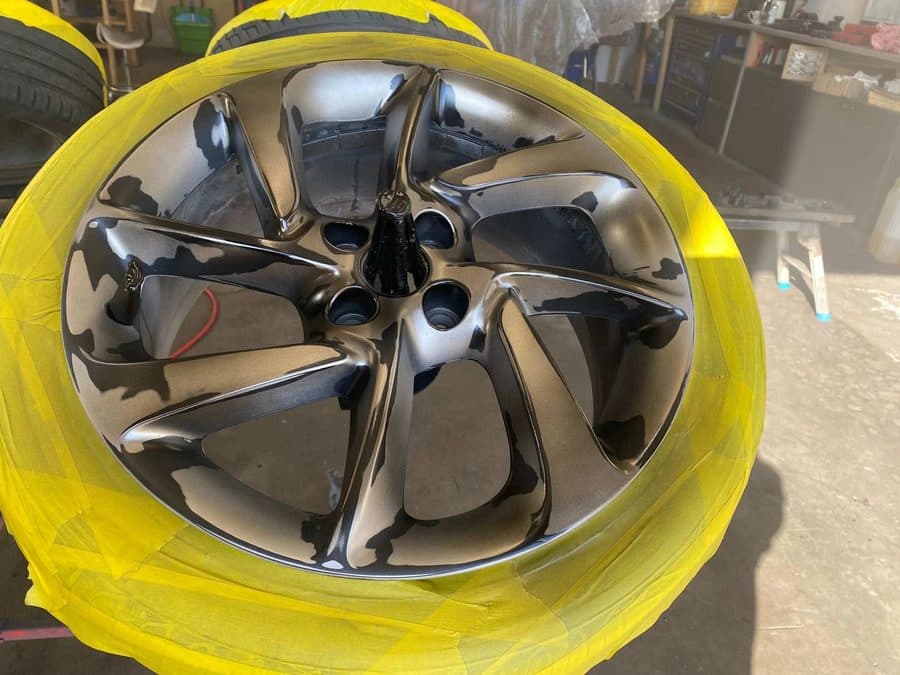
Alloy wheels corrode when water and road salt reach the bare metal, usually through a chip or a crack in the lacquer. Once it starts, the corrosion spreads underneath the finish and lifts it, which is why the lacquer peels. The fix is to take the old finish right back, seal the metal and refinish the wheel.
Below, we cover what starts the corrosion, why painting over it doesn't last, how we refurbish corroded alloys, what it costs, and how to slow it down once the wheels are done.
What causes alloy wheel corrosion?
Corrosion starts wherever the protective coating on the wheel has been broken. A kerb strike, a stone chip or a scratch from a tyre change opens a gap in the lacquer, and water gets to the metal underneath.
Wheel manufacturer Accuride describes the usual pattern: the corrosion begins at the damaged spot and then travels under the coating, in thin lines that lift it as they go. It also notes that de-icing products on winter roads make the problem worse. That is why corroded wheels often look worst after a winter of salted roads.
Why is the lacquer peeling off my alloys?
Peeling lacquer is usually the corrosion underneath pushing it off. Once lacquer starts lifting, water gets in behind it and the corrosion spreads on its own, so the peeling area grows.
It is the most common reason older alloy wheels look tired even when they have never been kerbed. White, powdery marks creeping in from the rim or around the spokes are the same thing at an earlier stage.
Can you just paint over corroded alloys?
Not if you want it to last. Paint over the top of corrosion and the corrosion carries on underneath, then lifts the new finish the same way it lifted the old one.
A proper repair takes the old finish right back and seals the bare metal before any new colour goes on. That preparation is where a refurbishment is won or lost. Skip it and the finish lifts within a season.
How we refurbish corroded alloy wheels
We strip the corrosion and the failed finish back, seal the metal, then refinish the wheel in stages:
Preparation on the Ayce wheel system, developed specifically for alloys, so the surface is clean and sound before anything goes on it.
UV primer filler, then a coat of primer.
Colour, matched to the rest of the set, or a different colour if you want one.
UV lacquer over the colour, for a tough and durable finish.
The work is done at our unit on Old Mill Lane Industrial Estate in Mansfield Woodhouse, indoors, so each coat goes on at the right pace. It is not a mobile service. More on the process is on our alloy wheel refurbishment page.
How long does it take?
It is an overnight job, so plan to leave the car with us.
How much does it cost?
As a guide, £70 a wheel or £240 for a set of four, including VAT, for most wheel sizes. Every job is still estimated on what the wheels need, so send us a photo and we will confirm the figure.
Is a corroded alloy wheel safe? Will it fail the MOT?
Surface corrosion and peeling lacquer are not MOT failures on their own. The MOT checks wheels for structural faults such as cracks and bad distortion, not for how they look. Our guide to whether kerbed or scuffed alloys can fail an MOT sets out what the tester actually checks.
A crack is a different matter. If a wheel is cracked or buckled rather than corroded, send us a photo before you book and we will tell you honestly whether it is worth refurbishing or needs replacing.
How to slow corrosion down once the wheels are done
You can't stop wheels picking up chips, but you can stop small damage turning into corrosion:
Wash the wheels regularly in winter, so road salt doesn't sit on them.
Deal with chips and kerb marks early, before water has time to get under the lacquer.
Use wheel cleaner as its maker directs, and rinse it off, rather than leaving it to sit on the finish.
If your wheels are already corroding or peeling, send us a photo or call us on 07713 175704. If the car is coming in for a valet, we can look at the wheels at the same time.
Source: Accuride, filiform corrosion on wheels.
Published: 11th November, 2026 | Updated: 11th November, 2026