
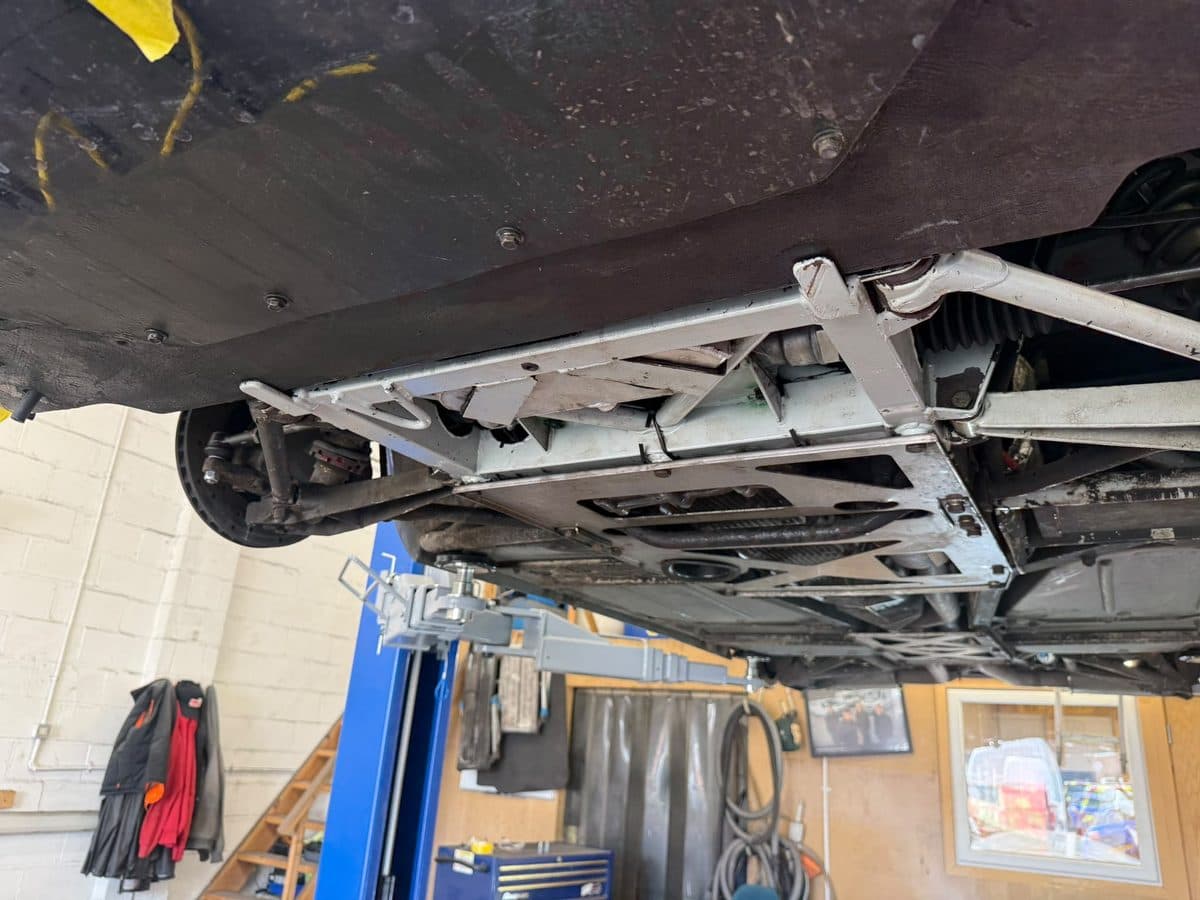
Old underseal has to come off before new protection goes on, and it's removed either by hand or by blasting. Coating makers such as Bilt Hamber start their underbody method with abrasive cleaning to strip old coatings. On the car, we use dry ice blasting, which lifts failed underseal without water or grit.
Below: why the old layer comes off first, the ways to remove it, what we put back on afterwards, and what the whole job costs.
Why old underseal comes off first
New protection needs to go onto a clean surface, not over a coating that has already failed. Bilt Hamber's guidance for protecting a rusted underside starts both its methods, the thorough one and the quick one, with "abrasive cleaning to remove old coatings and as much corrosion as possible".
There's a second reason. With the old coating off, the metal underneath can be seen properly for the first time. Corrosion, previous repairs and failed coatings all become visible, and that's often the point of the exercise. You can't judge what a car needs while the underside is still hidden.
The ways to remove it
By hand
Scrapers and wire brushes work on small, loose patches. A full underside by hand is a long job.
Abrasive blasting
Abrasive blasting strips old coatings back, and it's how Bilt Hamber's method begins. The drawback on a car is the grit. It lodges in panel seams and moving parts and is hard to get back out. We use sandblasting, but only on wheels and calipers once they're off the car, where there's nothing around them for the grit to reach.
Dry ice blasting
Dry ice blasting fires solid CO2 pellets at the surface. On impact they turn straight from solid to gas, and the expansion lifts the contamination away from the metal. Failed underseal, oil, road film and old coatings come off with no water near the electrics and no grit left behind. That's why anything we clean on the car is done with dry ice.
It isn't a rust cure, though. Dry ice clears the muck from around corroded metal so the damage can be assessed, but it doesn't treat rust. Where metal has pitted or gone through, the clean is preparation for the repair rather than the repair itself. Our dry ice cleaning page covers the process in full.
What goes back on afterwards
Once the underside is clean, we protect it with Dinitrol for corrosion protection and a Soudal anti-rust coating. Doing the clean and the protection in one visit means the protection goes onto bare, freshly cleaned metal rather than whatever was there before.
What it costs
As a guide, a full underside dry ice clean with protection afterwards is around £2,000, including VAT. If you'd rather have the underside pressure washed before protection, that's around £500.
Every job is still estimated when we see the car. The scope sets the price: a set of wheel arches costs less than a full underside stripped back, and a 4x4 takes longer than a hatchback.
Do I always need the old underseal stripped?
Not always. Where the existing coating is still sound, the pressure-washed route before protection can be enough. We'll tell you which one the car needs once it's on the lift.
Booking
All the work happens at our unit on Old Mill Lane Industrial Estate in Mansfield Woodhouse, by appointment. It isn't a mobile service. Most dry ice jobs take a full day, so plan to leave the car with us.
Published: 28th October, 2026 | Updated: 28th October, 2026